


Spectral Radiometric Calibration System for 4-meter Diameter Space Camera

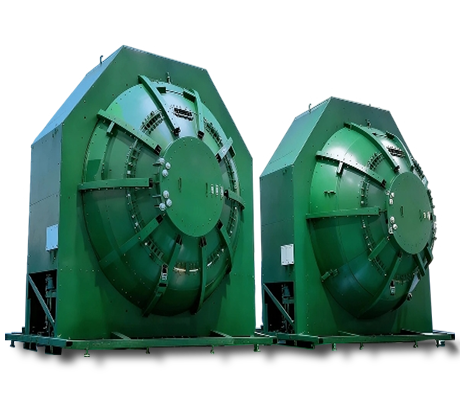
This system is used to test and calibrate the spectral and radiometric response characteristics of large-aperture space optical cameras. It provides continuously tunable, traceable spectral and radiometric inputs for camera calibration. The system includes a radiometric calibration subsystem and a spectral calibration subsystem. Radiometric calibration establishes the conversion between the camera’s digital number (DN) output and incident spectral radiance, and characterizes its radiometric performance. Spectral calibration identifies the camera’s spectral band response characteristics.
Key Parameters Measured by the Radiometric Calibration System
Number | Parameters |
1 | saturation exposure |
2 | dark noise |
3 | band-integrated radiance response range |
4 | radiance response range |
5 | dynamic range |
6 | linearity and linear response range |
7 | nonuniformity of response |
8 | Response Non-Uniformity Correction Factor |
9 | bias (dark signal) |
-
01/One-click control technology for radiance/irradiance.
-
02/Fine-tuning control and calibration technology for radiance/irradiance
-
03/High dynamic range adjustment capability for radiance/irradiance
-
04/Built-in color temperature tuning and spectral enhancement measures for the blue and green bands
-
05/Symmetrical distribution of the built-in light source to ensure uniformity control at any radiance point
-
06/Calibration technology for non-linear radiance points
-
07/Optical power monitoring and detection technology with sensitivity up to the fA level
-
08/Provision of multi-point radiance/irradiance values
-
09/Traceability to national spectral radiation standards
Project | Parameters | |
Inner diameter of integrating sphere(mm) |
4000 | |
Effective opening diameter of integrating sphere(mm) | 1000 (customizable) | |
uniformity | Lower than 2% | |
Radiance angular distribution nonuniformity | ≤2%(@±25°) | |
Integrating sphere light source instability (/hr) | ≤0.4% | |
Uncertainty in the calibration of absolute radiance | Lower than 5%@SNR³50 | |
Radiometric resolution(W/m2-sr) | 0.01 | |
Dynamic Range of the Integrating Sphere Light Source | ≥10000 | |
Integrated radiance in the highest band(W/m2-sr) | ≥230 (band 400nm~1080nm): (band 400nm~1080nm) | |
Integrated radiance in the lowest band(W/m2-sr) | £ 0.02(band 400nm~1080nm) | |
Spectral range of integrating sphere light source(nm) | 350-2500 | |
Color temperature of the built-in light source(K) | 3000K~5000K (tunable) | |
Effective working life of the light source(hr) | ≥1000 | |
Integrating sphere coating materials | PTFE | |
Cooling method | Air cooling/Water cooling | |
Spectrometer | Detection Band(nm) | 400-1080 |
Spectral resolution(nm)
| 3 | |
Straylight coefficient | 0.05% | |
Radiation Monitoring Using Photodetectors | Effective detection range | 1010 |
Input noise current(pA) | Lower than 0.3 | |
offsetdrift(pA/hr) | Lower than 0.3 | |
Radiance calibration quantity | ≥100 | |
software functions | Windows system | |
Offering available DLL or operating software | ||
Documentation and retention of the entire calibration test process | ||
Automatic Control of Radiance | ||
Real-time recording and display of dynamic spectral radiance data | ||
Real-time Recording and Display of Band-Integrated Radiance | ||
Light Source Malfunction Power-On Diagnosis | ||